
Trade Rationale
Read about our thoughts on the recent changes to our strategies
Rebalance Abbott Laboratories (ABT), Procter & Gamble (PG), DuPont de Nemours (DD), Bank of America (BAC), JPMorgan Chase (JPM), PNC Financial (PNC), U.S. Bancorp (USB), and Wells Fargo (WFC) and Added Increased AstraAzeneca (AZN)
We rebalanced our position in Abbott Laboratories to its model weight of 3.75% in the Core Dividend strategy. Abbott's Medical Devices segment remains the primary driver of our thesis, led by the FreeStyle Libre continuous glucose monitoring franchise, which continues to benefit from broader adoption, product upgrades, and increasing compatibility with automated ...

Rebalance Abbott Laboratories (ABT), Procter & Gamble (PG), DuPont de Nemours (DD), Bank of America (BAC), JPMorgan Chase (JPM), PNC Financial (PNC), U.S. Bancorp (USB), and Wells Fargo (WFC)
We rebalanced our position in Abbott Laboratories to its model weight of 3.75% in the Dividend Growth strategy. Abbott's Medical Devices segment remains the primary driver of our thesis, led by the FreeStyle Libre continuous glucose monitoring franchise, which continues to benefit from broader adoption, product upgrades, and increasing compatibility with automated ...
Exit Eastman Chemical (EMN) and Increase Solstice Advanced Materials (SOLS)
We exited Eastman Chemical (EMN) across the Dividend Growth, Core Dividend, and Quality Growth strategies as the circular-economy growth platform that anchored our thesis has failed to execute on schedule, while the credit and payout profile has moved in the wrong direction. We built the position around Eastman’s transition from a cyclical commodity chemicals producer toward a specialty and sustainable materials platform, with molecular recycling (methanolysis) as the centerpiece of that shift...

Add CME Group (CME), AstraZeneca (AZN) and Xylem (XYL)
We initiated a 1.25% position in CME Group in Brookmont’s Core Dividend Strategy, the world's largest derivatives exchange operator, where banks, asset managers, corporations, and traders use futures and options to hedge interest rates, equities, currencies, energy, metals, and agricultural exposures. We view it as one of the highest-quality and most defensive franchises in the sector, protected by a durable moat.

Add CME Group (CME) and Xylem (XYL) Increase Johnson & Johnson (JNJ)
We initiated a 1.25% position in CME Group in Brookmont’s Dividend Growth Strategy, the world's largest derivatives exchange operator, where banks, asset managers, corporations, and traders use futures and options to hedge interest rates, equities, currencies, energy, metals, and agricultural exposures. We view it as one of the highest-quality and most defensive franchises in the sector, protected by a durable moat.

Increase Qnity Electronics (Q) and Decrease Arthur J. Gallagher (AJG)
We increased our position in Qnity Electronics to 3.75% in Brookmont’s Dividend Growth and Core Dividend Strategies as the global semiconductor cycle continues to improve, with the strongest demand tied to AI, advanced computing, memory, advanced packaging, and increasingly complex chip architectures. As a leading pure-play electronics materials provider, Qnity is well positioned to benefit from rising semiconductor content intensity. The company’s portfolio is ...

Exit United Parcel Services (UPS) and Decrease U.S. Bancorp (USB) and Comcast (CMCSA)
After multiple years of underperformance and limited visibility into sustained improvement in the global small-parcel market, we exited our position in UPS in Brookmont’s Dividend Growth and Core Dividend Strategies. We believe the issue is no longer simply a cyclical volume trough. UPS continues to manage through a strategic reset, including the Amazon volume glide-down and network restructuring, while domestic package volume and margins remain pressured. At the same time, the company remains committed to a large dividend, creating a mismatch ...

Exit Estée Lauder (EL) and Increase Costco (COST)
We exited our position in Estée Lauder and increased our position in Costco to a weight of 2.50% in Brookmont's Quality Growth Strategy. Estée Lauder has been under pressure for several years following its post-COVID peak. Shifting consumer preferences in beauty and continued disruptions to travel retail have driven much of the weakness. Despite this, EL still trades at a high P/E multiple in line with the broader beauty industry....

Increase NetEase (NTES)
We increased our position in NetEase to a weight of 2.50% in Brookmont's Dividend Growth and Core Dividend Strategies. Although technically a communications/entertainment company, NetEase has been caught up in the drawdown across software names over the past few months. We view the company as well insulated from AI disruption within the video game space. NetEase's MMO (massive multiplayer online) titles rely on functional in-game economies, which are difficult to replicate without large player bases and are easily compromised by the kinds of exploits common in vibe-coded products. Live-service games more broadly also require resilient backend infrastructure to maintain reliable uptime at scale. Our thesis on NetEase's durable franchises and consistent execution is unchanged.

Increase Alphabet (GOOGL)
We increased our position in Alphabet to a weight of 3.75% in Brookmont's Quality Growth Strategy. AI model development has moved quickly over the past six months, and Google's Gemini 3 materially improved the company's competitive standing, moving it from a lagging position into the top tier of frontier models. That shift addresses one of our primary reservations about the stock: the risk that Google was losing ground on AI capability relative to peers. With that concern diminished, we have greater conviction in the position.

Increase Analog Devices (ADI)
We increased our position in Analog Devices to a weight of 3.75% in Brookmont's Dividend Growth and Core Dividend Strategies. Analog chips and microcontrollers are entering a fresh growth cycle. Following a year of weakness, demand trends and inventory levels have improved materially over the past few quarters. ADI also has several structural tailwinds: the proliferation of sensors and processors across products to collect data for the internet of things and AI applications, and an entrenched position in battery management systems with design wins at many of the top electric vehicle manufacturers. High-performance battery management improves accuracy and extends effective range, making Analog critical to EV performance. ADI is also a leader in wireless battery management, which eliminates wiring harnesses and reduces component costs, an area where adoption is still early.

Rebalance Microsoft (MSFT)
We rebalanced Microsoft to a weight of 3.75% in Brookmont's Dividend Growth and Core Dividend Strategies. The stock has traded down with the broader software industry over the past few months on concerns that AI poses disruption risk to incumbent software businesses. Broader market volatility from the Iran conflict added further downward pressure. We view this as a compelling rebalance point. Microsoft's business productivity suite is the most deeply entrenched in the world, and we see minimal replacement risk from AI. On the geopolitical side, the conflict introduces near-term uncertainty but does not change our expectation for a multi-year growth cycle in cloud computing demand as AI workloads continue to scale.

Add TE Connectivity (TEL) and Qualcomm (QCOM)
We added TE Connectivity at a weight of 2.50% and Qualcomm at a weight of 1.25% to Brookmont's Dividend Growth and Core Dividend Strategies. TE Connectivity offers compelling exposure to a broad set of structural growth themes, underpinned by consistent free cash flow generation, disciplined capital allocation, and a valuation that remains at a discount to peers. We view this combination as an attractive foundation for long-term value creation ....

Exit Accenture (ACN)
We exited our position in Accenture in Brookmont's Dividend Growth and Core Dividend Strategies. As advances in AI, once a meaningful tailwind to our thesis, have become what we expect will be a durable and accelerating headwind. We initiated the position in January 2015 at approximately $89 per share, with a thesis centered on the long-term shift toward outsourced services and consulting demand driven by the complexity of migrating from on-premises infrastructure to the cloud.

Exit Novo Nordisk (NVO)
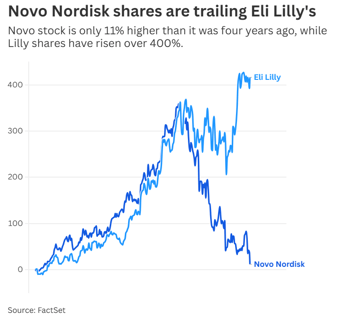
We exited our position in Novo Nordisk in Brookmont's Dividend Growth, Core Dividend, and Quality Growth strategies due to impairment of the investment thesis. We initiated our first position in October 2014 at a split-adjusted price of approximately $23, when our thesis centered on the company’s strong competitive position in diabetes treatment and the substantial, growing population of underpenetrated patients. At the time, the opportunity was supported by both insulin and early GLP-1 therapies, though the thesis was primarily driven by the broader expansion opportunity within type 2 diabetes.
Exit Diageo (DEO) and Add NetEase (NTES)
We exited our position in Diageo and added NetEase at a weight of 1.25% in Brookmont's Dividend Growth and Core Dividend Strategies. This reallocation reflects evolving global consumer dynamics, including the expansion of the global middle class alongside aging populations in developed markets. Younger consumers are increasingly moderating alcohol consumption and reallocating discretionary spending toward digital entertainment, particularly online gaming.

Add Qnity Electronics (Q) and Decrease DuPont du Nemours (DD)
We increasesd our postion in Qnity Electronics to a weight 2.50% and decreased our position in DuPont du Nemours to a weight of 2.5% in Brookmont's Dividend Growth and Core Dividend Strategies. Two portfolio companies, DuPont de Nemours and Honeywell, recently completed previously announced spins of certain businesses into separate publicly traded companies. Alongside these actions, we increased our weight in each of the new companies while also adjusting the weight of DuPont de Nemours to reflect its lower post-spin weight. We did not alter our weight in HON, as the size of the spin relative to the remaining company was not significant enough to materially impact the position weight.
Increase Solstice Advanced Materials (SOLS)
We increased our position in Solstice Advanced Materials to a weight of 1.25% in Brookmont's Dividend Growth, Core Dividend and Quality Growth Strategies. As a result of Honeywell’s spin-off of its Advanced Materials segment. The company holds advantaged positions across several end-markets with strong exposure to multiple long-term secular tailwinds.
Add Waste Management (WM)
We added Waste Management at a weight of 2.50% in Brookmont's Dividend Growth Strategy and at a weight of 1.25% in Brookmont's Core Dividend Strategy. This is due to the company’s entrenched market position, inflation-resilient business model, and upcoming acceleration in free cash flow following a multi-year investment cycle.
Add Meta Platforms (META)
We added Meta Platforms at a weight of 2.50% in Brookmont's Quality Growth Strategy due to our improved assessment of the company’s prospects. This addition has meaningfully reduced our prior underweight position, although the 2.50% allocation remains below META’s weighting in the Russell 1000.
Rebalance Broadcom (AVGO), Increase Microsoft (MSFT) and NVIDIA (NVDA), Decrease Constellation Brands (STZ) and Eastman Chemical (EMN), and Exit UnitedHealth Group (UNH)
We rebalanced Broadcom to a weight of 5.00%, increased our position in Microsoft to a weight of 7.50%, increased our postion in NVIDIA at a weight of 7.50%, decreased our position in Constellation Brands to 1.25%, decreased our position in Eastman Chemical to a weight of 1.25% and exited our positon in UnitedHealth Group in Brookmont's Quality Growth Strategy.
Recent strong performance resulted in Broadcom increasing past 6.25% of the strategy weight. Per our risk mandates, we rebalanced AVGO back to its model weight of 5.00%.
We increased Microsoft in order to maintain an overweight to its weight in the benchmark, reflecting our continued conviction in the holding. Microsoft offers durable compounding via leadership in productivity software, Azure, and AI. Office 365’s Copilot is broadly integrated, driving measurable productivity gains, pricing power, and higher ARPU.
Increase BWX Technologies (BWXT) and Gilead Sciences (GILD)
We increased our position in BWX Technologies’ to a model weight of 3.75% and our position to Gilead Sciences to a model weight of 3.75% in Brookmont's Core Dividend Strategy to better reflect its current weight in the composite due to the recent strong performance. Additionally, we rebalanced BWXT down to its updated model allocation, which allowed us to realize some gains from its recent strength while keeping a moderate overweight in the aerospace and defense industry.
We increased our position in Gilead Sciences because of our increasingly strong conviction in the underlying thesis. Gilead’s HIV leadership underpins stable, high-margin cash flows with long therapy duration and limited LOE risk this decade.
Rebalance Novo Nordisk (NVO) and Exit Amgen (AMGN)
We rebalanced Novo Nordisk to a weight of 3.75% and exited our position in Amgen in Brookmont's Dividend Growth and Core Dividend Strategies. We believe that following the substantial downdraft, its valuation is extremely compelling, even when revising down growth expectations....
Our decision to exit Amgen was paired with our rebalance of NVO, in part to offset the increase in Health Care sector exposure. With multiple major products facing increased competition and/or facing LOE (loss of exclusivity) over the next few years—such as Prolia, Enbrel, and Otezla—we don’t believe that AMGN’s pipeline is robust enough to offset these revenue declines....
Decrease Chevron (CVX), Rebalance Wells Fargo (WFC) and JP Morgan (JPM)
We decreased our position in Chevron to a weight of 1.25% and rebalanced our position in Wells Fargo and JPMorgan to a model weight of 3.75% in Brookmont's Dividend Growth Strategy. We believe that on a broad market level, this recovery is overly optimistic and not currently justified by existing information.
In alignment with this view, we have reduced our positions in a number of companies within the strategy that are more exposed to potential macroeconomic headwinds. To be clear, we remain confident in the underlying long-term investment theses of these holdings, however we believe that it is prudent to reduce the portfolio’s risk in the current environment.
Rebalance RTX Corporation (RTX) and Decrease Microchip Technology (MCHP)
We rebalanced our position in RTX Corporation to a weight of 1.25% and decreased our position in Microchip Technologies to a weight of 1.25% in Brookmont's Dividend Growth and Core Dividend Strategies. We have recently made the following changes to better align it with an uncertain and volatile macroeconomic environment. Following Liberation Day, major indices plunged and bordered on bear market territory. However, since then, we have seen almost a complete recovery in stock prices. The full impact of most of the retaliatory tariffs were suspended, however there have not been any definitive agreements with major trade partners signed, and the volatility of policy rhetoric from the administration has persisted. We believe that on a broad market level, this recovery is overly optimistic and not currently justified by existing information.
Rebalance Novo Nordisk (NVO) and Gilead Sciences (GILD)
We rebalanced our positions in Novo Nordisk and Gilead Sciences to a weight of 3.75% in Brookmont's Dividend Growth Strategy. At the strategy level, these adjustments maintain our current level of Health Care sector exposure while capitalizing on a notable divergence in recent share price performance between the two holdings.